
Project Location: Balamballe District, Galguduud Region, Galmudug State, Somalia
Project Reference: BALAMBALLE-005
Design Date: December 2021
Project Type: Airport planning, civil engineering design and runway development
Client/Beneficiary: Balamballe District Community
Project Status: Proposed design with initial site and runway preparation activities
Project Overview
The Proposed Balamballe Airport Project is an important infrastructure initiative developed to improve transportation, accessibility and economic opportunities for the people of Balamballe District and the wider Galguduud region of Somalia.
The project was planned as a community-focused airport development designed to provide a safe and organized aviation facility for Balamballe. The proposed airport will support passenger movement, emergency services, humanitarian operations, government activities, business travel and the transportation of essential goods.
Located in Balamballe District in Galmudug State, the project responds to the growing need for reliable air connectivity between the district and other parts of Somalia. Road transportation across central Somalia can be affected by long travelling distances, difficult terrain and seasonal weather conditions. A properly developed airport can significantly reduce travel time and provide an alternative means of transportation for the local community.
The airport design was prepared under Project Number BALAMBALLE-005 and includes the principal planning, civil engineering and standard construction drawings required to guide the proposed development.
Project Vision
The main vision of the project is to establish a safe, functional and expandable airport that can serve the current and future transportation needs of Balamballe District.
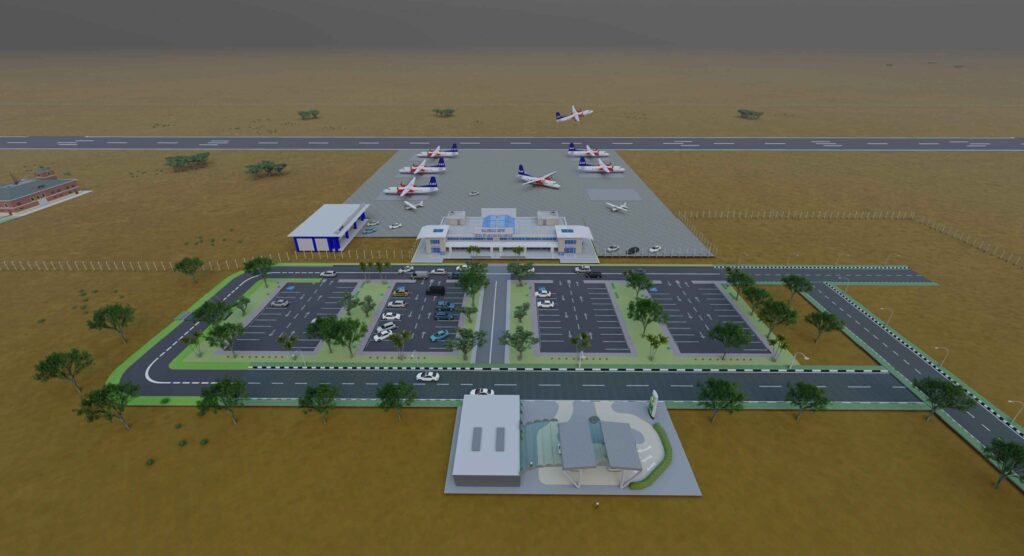
The airport master plan was developed to organize the runway, apron, terminal facilities, access roads, parking areas, security infrastructure and supporting services within one coordinated site layout. The proposed arrangement also considers the possibility of future expansion as passenger demand, commercial activity and aviation services increase.
The project is intended to become an important public infrastructure asset for Balamballe and surrounding communities. Beyond supporting aviation, the development can help attract investment, improve government and humanitarian access and create new employment opportunities during construction and airport operations.
Engineering Design Scope
The proposed design package covers the main technical components required for airport planning and civil works.
The general documentation includes the project cover information, drawing abbreviations and general engineering notes. These documents provide the standards, references and instructions required to understand and implement the design.
The mapping and planning section includes the airport master plan, general site topography and runway charts. The topographical information is essential for understanding the existing ground elevations, natural drainage patterns and physical conditions of the site. The airport master plan coordinates all major facilities and shows how the different operational areas will function together.
The civil engineering drawings include the runway plan and profile, typical cross-sections, apron details and fence-wall details. These drawings provide guidance for site preparation, earthworks, levels, runway formation, pavement construction and security boundaries.
Standard drawings were also prepared for the runway’s typical layout, typical cross-section and turnpad arrangement. The turnpad is intended to provide an area where aircraft can safely turn at or near the end of the runway.
Proposed Airport Facilities
The conceptual design presents a complete airport layout rather than only a runway. The proposed development includes the runway, aircraft apron, terminal-related buildings, access roads, vehicle parking, landscaped areas, airport service facilities and perimeter security.
The runway forms the central operational element of the project. It is planned to provide a prepared and clearly defined surface for aircraft take-off and landing. Its alignment was selected in relation to the available land, surrounding terrain and the overall airport master plan.
The apron is positioned near the terminal area to provide space for aircraft parking, passenger boarding, unloading and ground-handling activities. The apron layout is designed to allow several aircraft to be accommodated while maintaining organized movement between the runway and terminal facilities.
The proposed terminal zone includes passenger-handling buildings and related operational facilities. The design also provides vehicle circulation routes and parking areas to separate airport traffic from aircraft operations.
Landscaped areas and organized access roads have been incorporated into the concept to create an attractive and functional entrance to the airport. The overall arrangement is intended to improve passenger experience while maintaining safety and operational control.
Runway and Site Preparation Activities
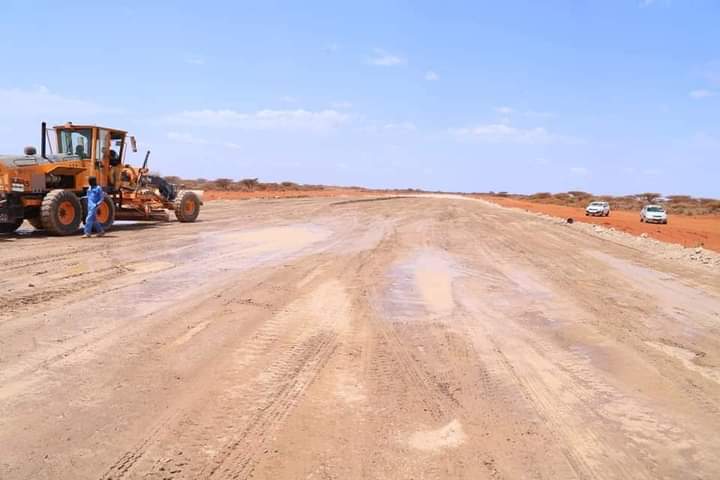
The project photographs show important early-stage activities associated with runway and airfield development.
Initial works included site clearing, grading, watering and compaction of the runway formation. These activities are necessary to create a stable, level and well-compacted platform before the final runway pavement layers are constructed.
Motor graders were used to spread and level the prepared material across the runway area. Grading helps establish the required surface profile, longitudinal levels and crossfall. Correct levels are particularly important for runway safety and stormwater drainage.
Water tankers were used to apply controlled moisture to the construction material. Moisture conditioning is an important part of earthwork compaction because soil and selected fill materials must contain an appropriate amount of moisture to achieve the required density.
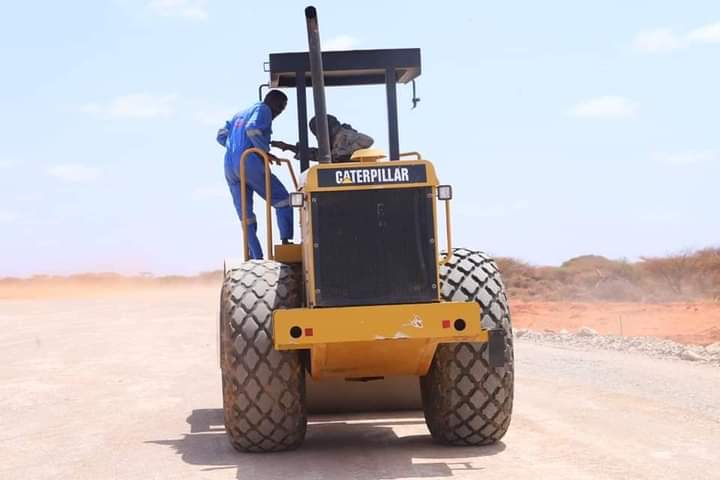
Rollers and compaction equipment were then used to compact the prepared surface. Proper compaction reduces settlement, improves bearing capacity and provides a stable foundation for the upper pavement layers.
The photographs also demonstrate the scale and width of the prepared runway corridor. The works were carried out over a wide, open site with sufficient space for construction machinery, runway development and future airport facilities.
Earthworks and Pavement Formation
Airport runways require carefully controlled earthworks because aircraft operations produce significant loads that must be safely transferred through the pavement structure into the underlying ground.
The site-preparation process generally begins by removing unsuitable materials and clearing the proposed runway area. The natural ground is then shaped according to the approved runway profile. Where required, suitable fill material is placed in controlled layers.
Each layer must be spread evenly, moisture-conditioned and compacted before the next layer is added. This controlled construction process helps prevent weak zones, differential settlement and surface deformation.
The prepared subgrade forms the foundation of the runway pavement. Depending on the final engineering specifications, additional selected subgrade, sub-base, base-course and surface layers may be installed above it.
Quality testing should be conducted throughout the earthworks and pavement construction. Testing may include material classification, moisture-content testing, field-density testing, compaction verification, level surveys and bearing-capacity assessments.
Drainage Considerations
Effective drainage is one of the most important elements of airport design. Water must not be allowed to remain on the runway or penetrate and weaken the pavement foundation.
The runway profile and cross-sections should therefore provide sufficient slopes to direct rainwater away from the operational surface. Side drains, channels, culverts and natural discharge routes may be incorporated according to the final drainage assessment.
The surrounding airport grounds should also be graded to prevent water from flowing toward the runway, apron, terminal buildings or access roads. Proper drainage will protect the infrastructure, reduce maintenance requirements and improve long-term operational safety.
Airport Safety and Security
Safety is a fundamental requirement throughout airport planning, construction and operation. The proposed Balamballe Airport design provides defined operational zones for aircraft, vehicles, passengers and airport personnel.
The runway, apron and aircraft-movement areas must remain protected from unauthorized access. The design documentation therefore includes details for the airport perimeter fence wall and other boundary-security measures.
Clear separation is required between public areas and restricted airside areas. Vehicle access, passenger entry points, service routes and emergency access should all be controlled through the final operational plan.
Runway markings, directional signs, lighting systems, windsocks and other navigational or visual aids may be introduced according to the airport’s final operational category and the requirements of the responsible aviation authorities.
Before the airport becomes operational, the completed infrastructure should undergo technical inspections and obtain all required approvals from the relevant civil aviation authorities.
Quality-Control Approach
Quality control is essential to ensure that the airport infrastructure performs safely throughout its service life.
Construction materials should be inspected and tested before being incorporated into the works. Earthwork and pavement layers should be installed at the approved thicknesses and compacted to the densities specified in the engineering documents.
Survey teams should regularly confirm the runway alignment, elevations, width, crossfall and overall geometry. Any areas that do not meet the required standards should be corrected before subsequent layers are constructed.
Construction equipment should also be maintained in good working condition. Graders, water tankers, rollers and other machinery must be operated by qualified personnel and coordinated under proper site supervision.
Health, safety and environmental procedures should be applied throughout the project. These procedures should address machinery movement, worker protection, dust control, access management and safe working around active construction zones.
Social and Economic Importance
The proposed airport has the potential to provide significant social and economic benefits to Balamballe District.
Improved air access can connect local communities to major cities and commercial centres more quickly. It can also support business owners, investors, government representatives, development organizations and members of the Somali diaspora travelling to the region.
The airport could play an important role during medical emergencies by facilitating faster transportation of patients, medical personnel and essential supplies. It could also improve the response capacity of humanitarian organizations during droughts, floods or other emergencies.
During the construction period, the project can create employment opportunities for equipment operators, drivers, surveyors, engineers, technicians, security personnel and general labourers. Once operational, the airport may create longer-term jobs in administration, passenger services, maintenance, ground handling, transportation and security.
The airport can also encourage development of supporting businesses such as hotels, restaurants, transport services, storage facilities, retail outlets and logistics operations.
Contribution to Regional Development
Balamballe is strategically located within central Somalia. Improved aviation infrastructure can strengthen its relationship with other districts and regions and increase the movement of people, goods and services.
The airport may support public-sector activities by providing faster access for government institutions and technical teams. It can also assist development partners conducting projects related to water, agriculture, education, healthcare and infrastructure.
By reducing the isolation of the district, the project has the potential to increase confidence among investors and encourage further development around the airport and within Balamballe town.
The airport should therefore be viewed not only as a transportation project but also as a long-term investment in regional development, community resilience and economic growth.
Environmental Considerations
Environmental protection should remain part of every stage of the proposed development.
During construction, water spraying can be used to control dust generated by grading, material transportation and compaction activities. Construction vehicles should use designated routes to reduce unnecessary disturbance to surrounding land.
Natural drainage channels should be protected or properly redirected, and excavated or unsuitable materials should be disposed of in approved locations. Fuel, lubricants and other construction materials should be safely stored to prevent contamination of the soil.
Vegetation removal should be limited to areas required for safe airport operations. Where appropriate, landscaping and replacement planting can be introduced around public and terminal areas.
Long-term airport planning should also consider noise, waste management, surface-water management and the protection of surrounding communities.
Future Development Potential
The master-plan approach allows the airport to be developed progressively.
The initial phase may focus on completing the runway, basic apron, safety areas, perimeter security and essential access infrastructure. Additional facilities can then be introduced according to operational demand and available funding.
Future phases may include an expanded passenger terminal, additional aircraft-parking positions, hangars, cargo-handling areas, airport administration buildings, emergency-response facilities, fuel services and improved navigational systems.
Land surrounding the main airport infrastructure should be protected from incompatible development so that future expansion remains possible.
A phased approach can help the community and responsible authorities manage project costs while gradually improving airport capacity and service quality.
Project Conclusion
The Proposed Balamballe Airport Project represents a major step toward improving accessibility and infrastructure in Balamballe District, Galguduud, Somalia.
The project combines airport master planning, topographical assessment, runway engineering, apron design, access planning and security infrastructure within a coordinated development concept. The construction photographs demonstrate important progress in clearing, grading, watering and compacting the proposed runway area.
When fully developed in accordance with approved engineering standards and aviation regulations, the airport can provide safer and faster transportation, support emergency and humanitarian operations and contribute to the economic development of Balamballe and the surrounding region.
This community-driven project reflects a long-term commitment to connectivity, opportunity and sustainable regional growth.g, geotechnical investigation, materials testing, engineering design and construction-supervision services.